Protected Member Functions | |
| str | _get_local_path (self, str path, **Any kwargs) |
| Union[IO[str], IO[bytes]] | _open (self, str path, str mode="r", int buffering=-1, Optional[str] encoding=None, Optional[str] errors=None, Optional[str] newline=None, bool closefd=True, Optional[Callable] opener=None, **Any kwargs) |
| bool | _copy (self, str src_path, str dst_path, bool overwrite=False, **Any kwargs) |
| bool | _exists (self, str path, **Any kwargs) |
| bool | _isfile (self, str path, **Any kwargs) |
| bool | _isdir (self, str path, **Any kwargs) |
| List[str] | _ls (self, str path, **Any kwargs) |
| None | _mkdirs (self, str path, **Any kwargs) |
| None | _rm (self, str path, **Any kwargs) |
 Protected Member Functions inherited from fastreid.utils.file_io.PathHandler Protected Member Functions inherited from fastreid.utils.file_io.PathHandler | |
| None | _check_kwargs (self, Dict[str, Any] kwargs) |
| List[str] | _get_supported_prefixes (self) |
Additional Inherited Members | |
| Static Protected Attributes inherited from fastreid.utils.file_io.PathHandler | |
| bool | _strict_kwargs_check = True |
Detailed Description
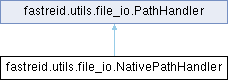
Handles paths that can be accessed using Python native system calls. This
handler uses `open()` and `os.*` calls on the given path.
Definition at line 184 of file file_io.py.
Member Function Documentation
◆ _copy()
|
protected |
Copies a source path to a destination path.
Args:
    src_path (str): A URI supported by this PathHandler
    dst_path (str): A URI supported by this PathHandler
    overwrite (bool): Bool flag for forcing overwrite of existing file
Returns:
    status (bool): True on success
Reimplemented from fastreid.utils.file_io.PathHandler.
Definition at line 254 of file file_io.py.
◆ _exists()
|
protected |
Checks if there is a resource at the given URI.
Args:
    path (str): A URI supported by this PathHandler
Returns:
    bool: true if the path exists
Reimplemented from fastreid.utils.file_io.PathHandler.
Definition at line 285 of file file_io.py.
◆ _get_local_path()
|
protected |
Get a filepath which is compatible with native Python I/O such as `open`
and `os.path`.
If URI points to a remote resource, this function may download and cache
the resource to local disk. In this case, this function is meant to be
used with read-only resources.
Args:
    path (str): A URI supported by this PathHandler
Returns:
    local_path (str): a file path which exists on the local file system
Reimplemented from fastreid.utils.file_io.PathHandler.
Definition at line 190 of file file_io.py.
◆ _isdir()
|
protected |
Checks if the resource at the given URI is a directory.
Args:
    path (str): A URI supported by this PathHandler
Returns:
    bool: true if the path is a directory
Reimplemented from fastreid.utils.file_io.PathHandler.
Definition at line 293 of file file_io.py.
◆ _isfile()
|
protected |
Checks if the resource at the given URI is a file.
Args:
    path (str): A URI supported by this PathHandler
Returns:
    bool: true if the path is a file
Reimplemented from fastreid.utils.file_io.PathHandler.
Definition at line 289 of file file_io.py.
◆ _ls()
|
protected |
List the contents of the directory at the provided URI.
Args:
    path (str): A URI supported by this PathHandler
Returns:
    List[str]: list of contents in given path
Reimplemented from fastreid.utils.file_io.PathHandler.
Definition at line 297 of file file_io.py.
◆ _mkdirs()
|
protected |
Recursive directory creation function. Like mkdir(), but makes all
intermediate-level directories needed to contain the leaf directory.
Similar to the native `os.makedirs`.
Args:
    path (str): A URI supported by this PathHandler
Reimplemented from fastreid.utils.file_io.PathHandler.
Definition at line 301 of file file_io.py.
◆ _open()
|
protected |
Open a path.
Args:
    path (str): A URI supported by this PathHandler
    mode (str): Specifies the mode in which the file is opened. It defaults
        to 'r'.
    buffering (int): An optional integer used to set the buffering policy.
        Pass 0 to switch buffering off and an integer >= 1 to indicate the
        size in bytes of a fixed-size chunk buffer. When no buffering
        argument is given, the default buffering policy works as follows:
            * Binary files are buffered in fixed-size chunks; the size of
            the buffer is chosen using a heuristic trying to determine the
            underlying device’s “block size” and falling back on
            io.DEFAULT_BUFFER_SIZE. On many systems, the buffer will
            typically be 4096 or 8192 bytes long.
    encoding (Optional[str]): the name of the encoding used to decode or
        encode the file. This should only be used in text mode.
    errors (Optional[str]): an optional string that specifies how encoding
        and decoding errors are to be handled. This cannot be used in binary
        mode.
    newline (Optional[str]): controls how universal newlines mode works
        (it only applies to text mode). It can be None, '', '\n', '\r',
        and '\r\n'.
    closefd (bool): If closefd is False and a file descriptor rather than
        a filename was given, the underlying file descriptor will be kept
        open when the file is closed. If a filename is given closefd must
        be True (the default) otherwise an error will be raised.
    opener (Optional[Callable]): A custom opener can be used by passing
        a callable as opener. The underlying file descriptor for the file
        object is then obtained by calling opener with (file, flags).
        opener must return an open file descriptor (passing os.open as opener
        results in functionality similar to passing None).
    See https://docs.python.org/3/library/functions.html#open for details.
Returns:
    file: a file-like object.
Reimplemented from fastreid.utils.file_io.PathHandler.
Definition at line 194 of file file_io.py.
◆ _rm()
|
protected |
Remove the file (not directory) at the provided URI.
Args:
    path (str): A URI supported by this PathHandler
Reimplemented from fastreid.utils.file_io.PathHandler.
Definition at line 310 of file file_io.py.
The documentation for this class was generated from the following file:
- smreid/fastreid/utils/file_io.py